The Galveston Bay system is both ecologically rich and economically important to the State of Texas, and the United States. Unfortunately, the system has endured substantial impacts to physical features that support ecologic and economic inputs to the region. Erosion along Galveston Bay’s shoreline has exceeded 4 feet per year in many areas, often made worse by ongoing subsidence and changes in seawater levels that expose these shorelines to more powerful erosional forces over time. A common response to erosion is to armor the shoreline with a hardened structure such as a bulkhead. Previous estimates indicate that approximately 10% of the Galveston Bay shoreline has been modified by hardened structures and more than 19% is classified as developed.
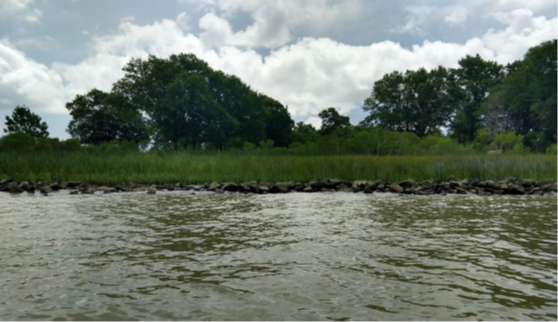
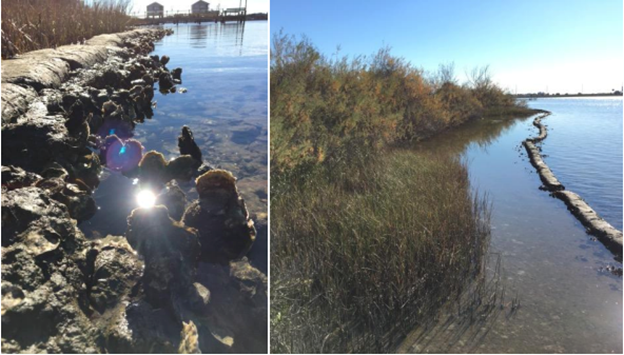
Living shoreline at Trinity Bay.
Over time, Living Shoreline (LS) restoration techniques have been developed as an ecologically friendly alternative to shoreline hardening while restoring lost aquatic habitat. These approaches are based on the premise that vegetated wetlands form a buffer between high-energy water and adjacent land, limiting or reversing shoreline erosion. Research suggests that the fringing marsh at the wetland edge is exceptionally important habitat for many important fishery species, in-turn helping generate an estimated $2.8B per year to the local economy through recreational fishing and related expenditures. Prior data suggests Living Shoreline projects are an ecologically beneficial option for erosion control and property protection. However,much of the scientific data regarding ecologic function comes from larger scale habitat restoration projects rather than smaller, privately owned sites reflective of many Living Shoreline sites along the Texas coast.
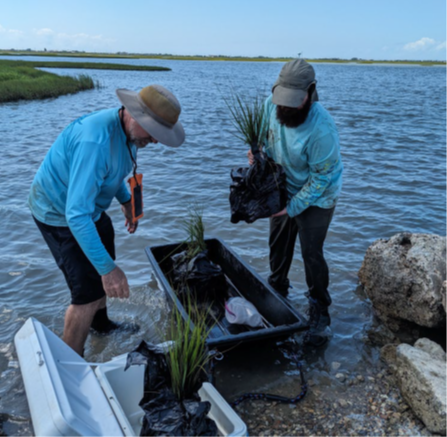
Researchers collecting plant samples for lab analyses at West Galveston Bay.
In 2023, researchers at Lee College, partnering with the University of Houston – Clear Lake, the Galveston Bay Foundation, and Black Cat GIS & Biological Services obtained funding from the Galveston Bay Estuary Program to compare the ecosystem services and overall health of wetlands with different types of shoreline protection. They compared marsh protected by hardened structures, marsh protected by living shorelines, and reference undisturbed marsh at three Living Shorelines sites (LVS) within the Galveston Bay system to attempt to assess the resiliency and functional aspects (biotic and abiotic) of these small-scale restoration projects. This work is part of an ongoing study extending back to 2018 and aims to collect repeated data over time to better understand how the Living Shoreline sites respond to ongoing stressors such as erosion caused by wave energy, and how well the sites support beneficial habitat functions relative to the hardened sites and natural, unrestored shoreline sites.
At each of the sites, researchers collected soil and plant samples, deployed minnow traps, and captured drone aerial imagery. They tested soil samples for microplastics and bacterial communities and the plant samples for the amount and number of different species and growth characteristics such as root and shoot size and chlorophyll production. The aerial imagery was used to compare the land cover change over the years, uncovering trends in shoreline integrity over time. The project was completed in May 2025.
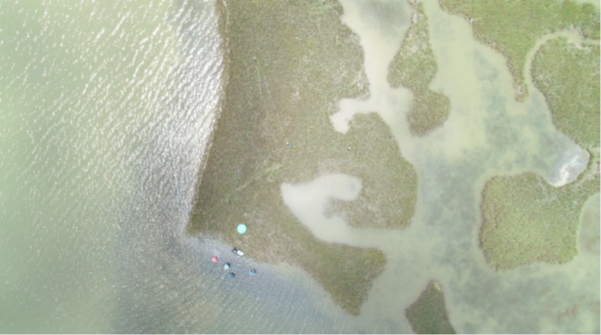
Drone image at West Galveston Bay looking down at the transect and landing site. Sea grasses are visible in the shallow water adjacent to the marsh habitat, adding complexity to the habitat that benefits the biological community by providing a range of resources.
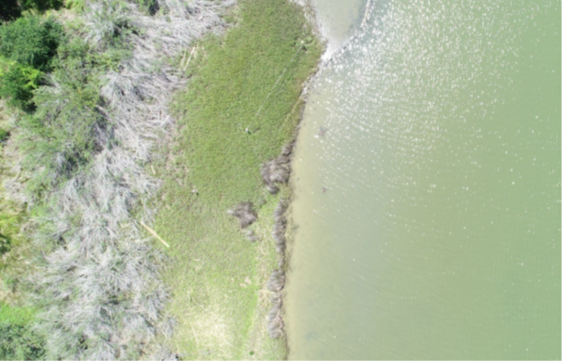
Drone image of the West Galveston Bay Living Shoreline site and transect. The low-profile breakwater is visible in the upper center with a shallow water habitat and the restored marsh. The shallow water habitat is exposed as a mudflat during low tide and is used extensively by schooling fish such as Atlantic croaker, shrimp, and crabs.
The data from this project show that the Living Shoreline sites studied protect against shoreline and adjacent land loss as well as, or better than, traditionally hardened shorelines while adding the benefit of restoring important fishery and wildlife habitat comparable to naturally vegetated shorelines. Also, the data from the study suggest that the Living Shoreline sites may prove to be more resilient than either naturally vegetated or armored shorelines over time to impacts of relative changes in seawater levels or strong erosive forces from storm events due to features of the Living Shoreline designs. This is in-part because Living Shorelines incorporate the beneficial aspects of sloped, vegetated shorelines along with the protective features of strategically designed structures such as breakwaters or low-profile revetments. When designed specifically for the target site conditions, the Living Shoreline approach to stabilization appears to be self-healing in the face of stressors of a dynamic coastal environment. This is good news for small-scale landowners and public infrastructure scale entities alike, as this approach can reduce long-term maintenance costs while reversing long-term losses of habitats existential to our regional economies.
West Galveston Bay Living shoreline site from the ground. The low-profile breakwater incorporates small gaps along its length that allow for fish and other aquatic organisms to access the constructed marsh along the shoreline. The height allows for sediment to overwash the top and collect behind the breakwater, helping to nourish the marsh while still protecting the shoreline from destructive wave-driven erosion. Eastern oysters (Crassostrea virginica) have colonized the breakwater, adding to the complexity of the biological community while also helping reinforce the breakwater and filter the water along the shoreline.